Freight Market Update for Q4 2026: Diesel, Truckload Rates, and the Next Turn in the Cycle

Flock Freight's Q4 2026 freight market update examines a truckload market that is still moving higher. We point to three forces shaping the quarter: diesel fuel cost, consumer demand, and supply exits. This quarter's freight market insights focus on what those forces mean for shippers and carriers, where rates may go next, and the economic factors that could accelerate or slow down our march towards the inflection point for truckload rates.
A Note from Chris Pickett, Flock Freight's Chief Commercial Officer
The Q4 story is that the supply-side correction is still working its way through the system, while demand is stable enough to support higher rates. Truckload rates are confidently in their Y/Y inflationary phase, but supply is still exiting due to soaring diesel prices.
Through the end of Q3, we saw no clear evidence that the cyclical correction higher in truckload spot and contract linehaul rates had peaked. We continue to expect Q4 to represent the year-over-year peak of this inflationary leg.
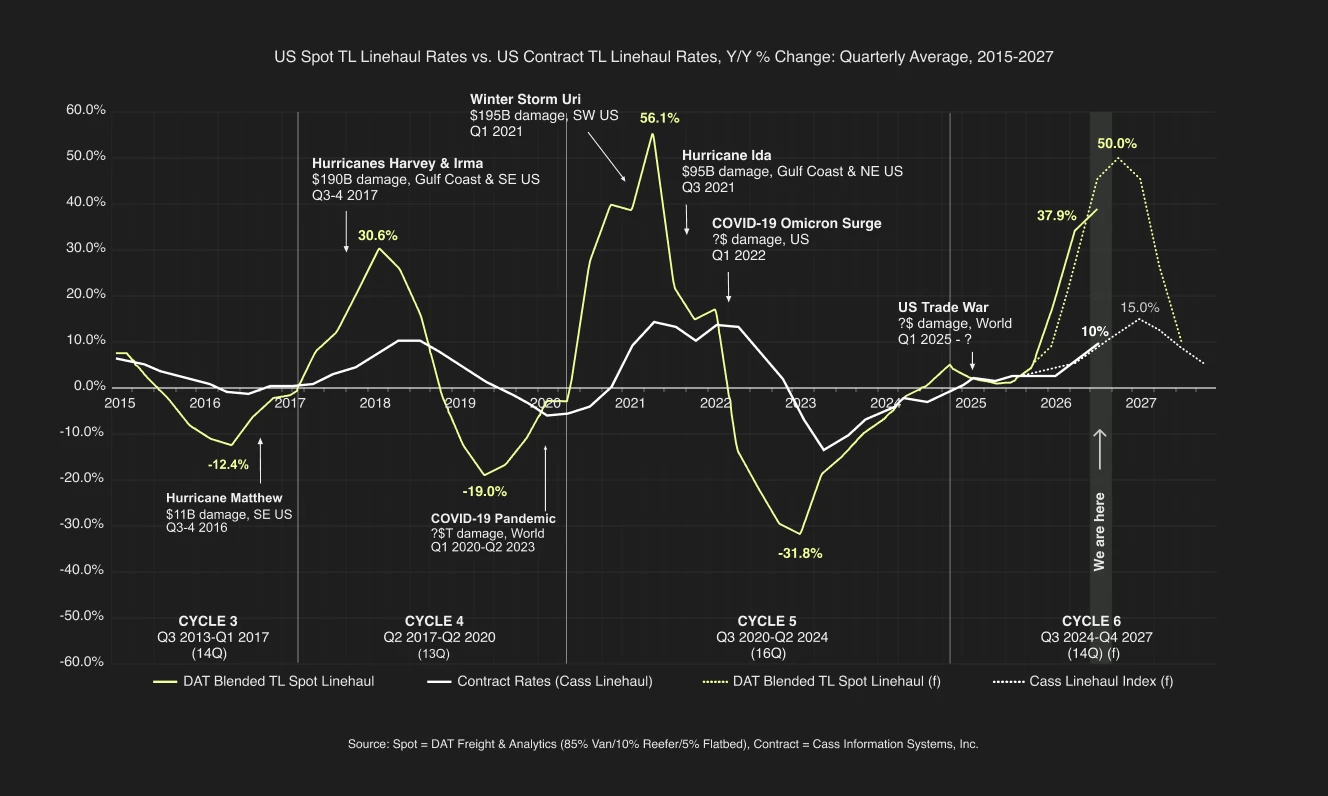
Our current view is that Q4 spot linehaul rates could reach approximately 50% year-over-year. That is lower than our earlier 60% peak forecast, but it still represents a significant increase from the Q3 close of 37.9% year-over-year. The exact pace will depend primarily on diesel prices, demand, how quickly capacity exits the market, and unpredictable tariff distortions.
Diesel is the most important variable from here. Higher fuel costs increase pressure on carriers, accelerate the exit of unprofitable capacity, and raise the cost of transportation for shippers. At the same time, fuel inflation can put pressure on consumer spending, which creates a potential counterforce by limiting freight demand. That tension will define the next several months.
Prefer a long form discussion on the market? Click here to access GoodShip’s freight market update webinar featuring Chris from October 20th.
What Freight Market Trends Should Shippers and Carriers Watch in Q4 2026?
- Diesel is still the headline: Diesel prices have surged roughly 80% year to date and are at record levels. For carriers, that can erase the benefit of higher spot rates and push operating margins back under pressure. For shippers, it raises both spot-market costs and the fuel surcharge component of contract rates.
- The supply correction continues: The truckload spot market only recently became unprofitable after remaining under pressure since early 2023. As surplus capacity exits, the market is balancing supply and demand. That supply-side recalibration is the primary reason rates can rise even without a major demand surge.
- Demand is stable, but not booming: Consumption is holding near pre-COVID levels, generally growing around 2% to 3% year-over-year. Services and nondurable goods remain relatively steady, while durable goods are recovering from a weaker period. Goods consumption matters most for truckload demand, and weak housing activity and high inflation continue to limit the upside.
- Industrial activity is improving gradually: Industrial production has held in positive year-over-year territory after several quarters of stagnation. The direction is constructive, but the improvement is not yet strong enough to describe the rate recovery as demand-led.
- Inventories are becoming more supportive: The inventory-to-sales ratio has moved down toward 1.29 to 1.30, a level not seen since early 2022. Lower relative inventories can create a need to replenish goods, which would support industrial activity and truckload demand if the trend holds.
- Tariffs continue to distort freight flows: Import activity has been affected by companies pulling freight forward ahead of tariff changes, followed by corrections when those shipments clear. That whipsawing is particularly visible in port and inland transportation flows. It can create short-term volume spikes without representing a durable change in underlying demand.
- Contract freight currently has an advantage over spot: Spot rates are typically transacted as an all-in price, while contract rates are structured as linehaul plus a fuel surcharge. With diesel rising quickly, all-in contract costs can increase faster than spot rates, making contract routing guides more attractive to carriers in the current environment. If diesel falls sharply, that relationship could reverse and send more freight into the spot market as contract rates get rejected by carriers.
Key Freight Market Numbers for Q4 2026
- Q3 spot linehaul rates: Closed at +37.9% year-over-year.
- Q4 spot rate outlook: Expected to reach approximately +50% year-over-year, making Q4 the likely year-over-year peak of the current inflationary cycle.
- Q3 contract rates: Closed at +10% year-over-year.
- Q4 contract rate outlook: Estimated to peak at +15% year-over-year in Q1 2027.
- Long-term rate trend: Spot and contract truckload linehaul rates have each grown about 2% annually over the past 15 years, but the path has been defined by sharp cyclical swings rather than a smooth upward line.
- Diesel prices: Up approximately 80% year to date and currently at record levels.
- Demand growth: Consumption remains broadly in the +2% to +3% year-over-year range, with goods consumption still below its strongest post-pandemic levels.
- Inventory-to-sales ratio: Approximately 1.29 to 1.30, an increasingly constructive signal for future production & replenishment needs.
Shared Truckload Spotlight
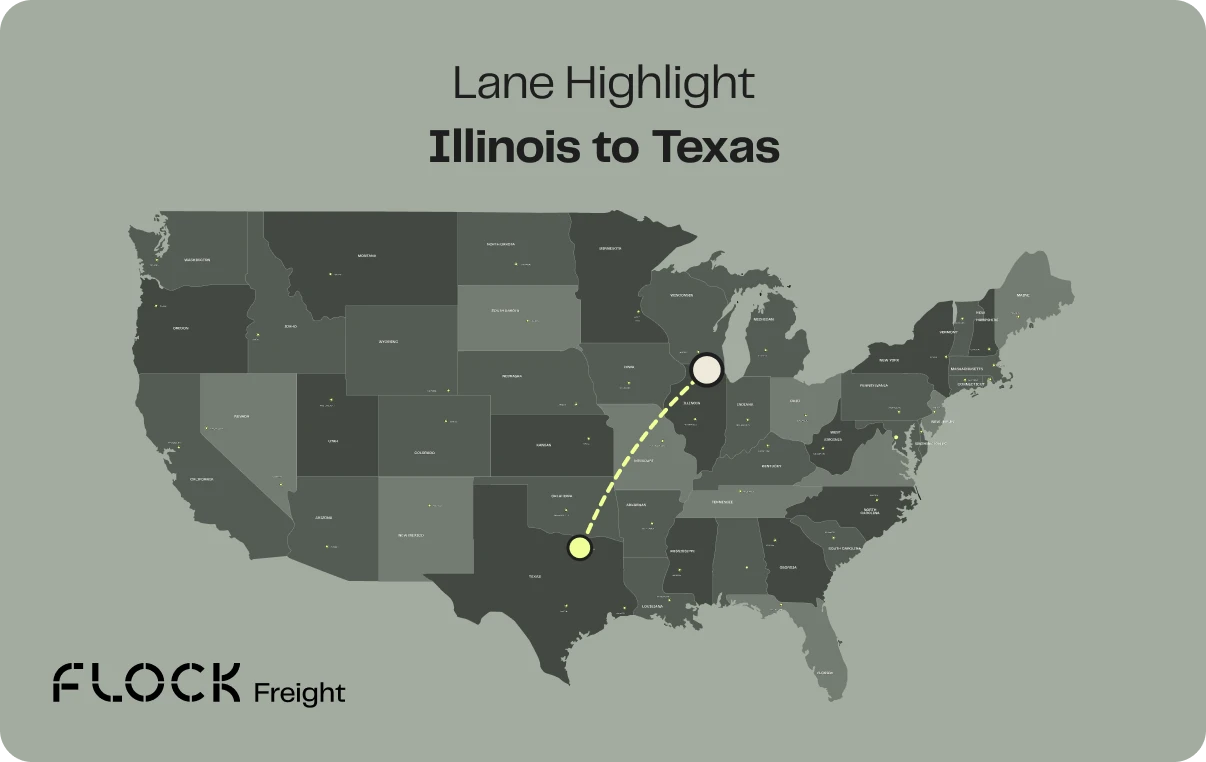
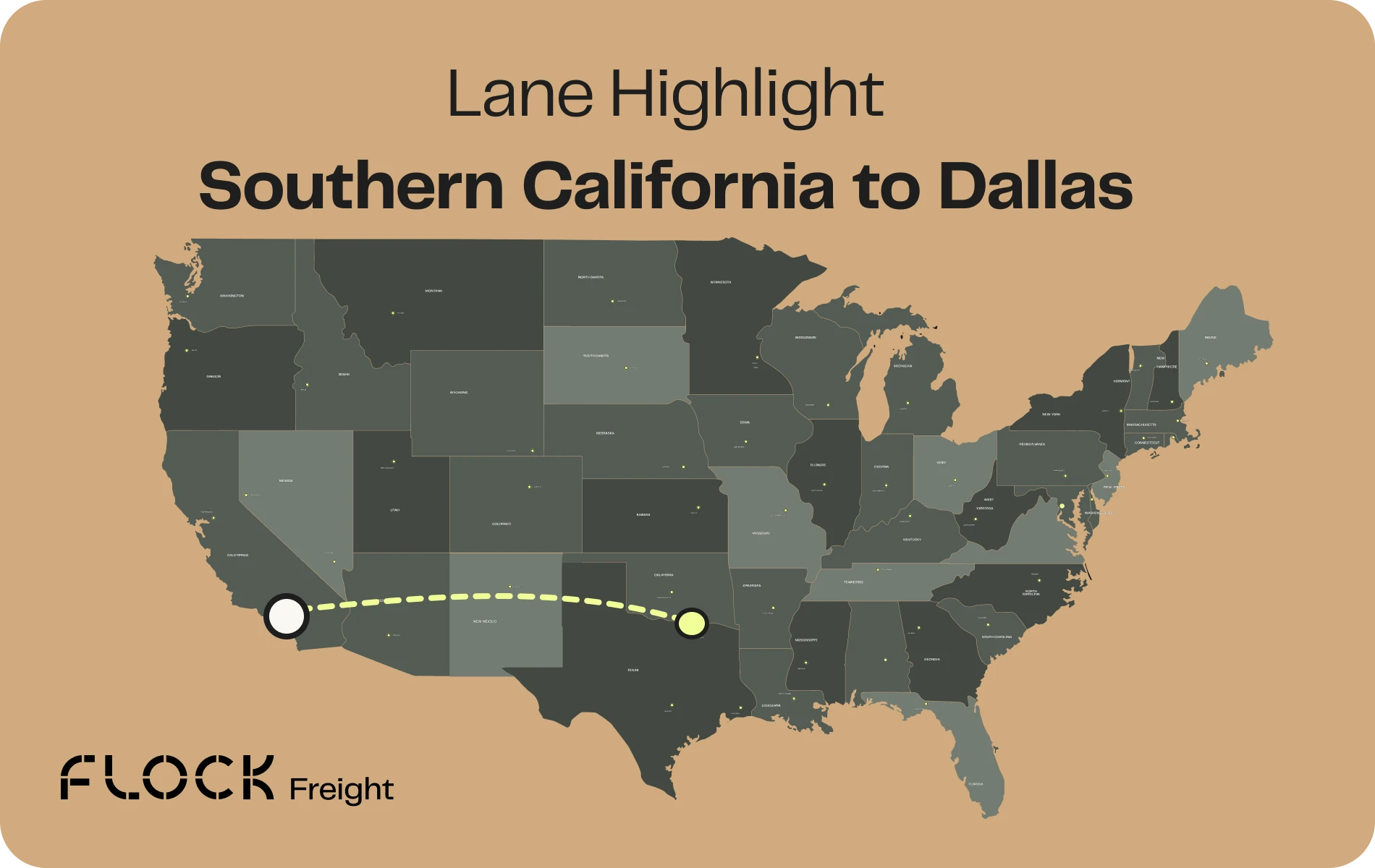
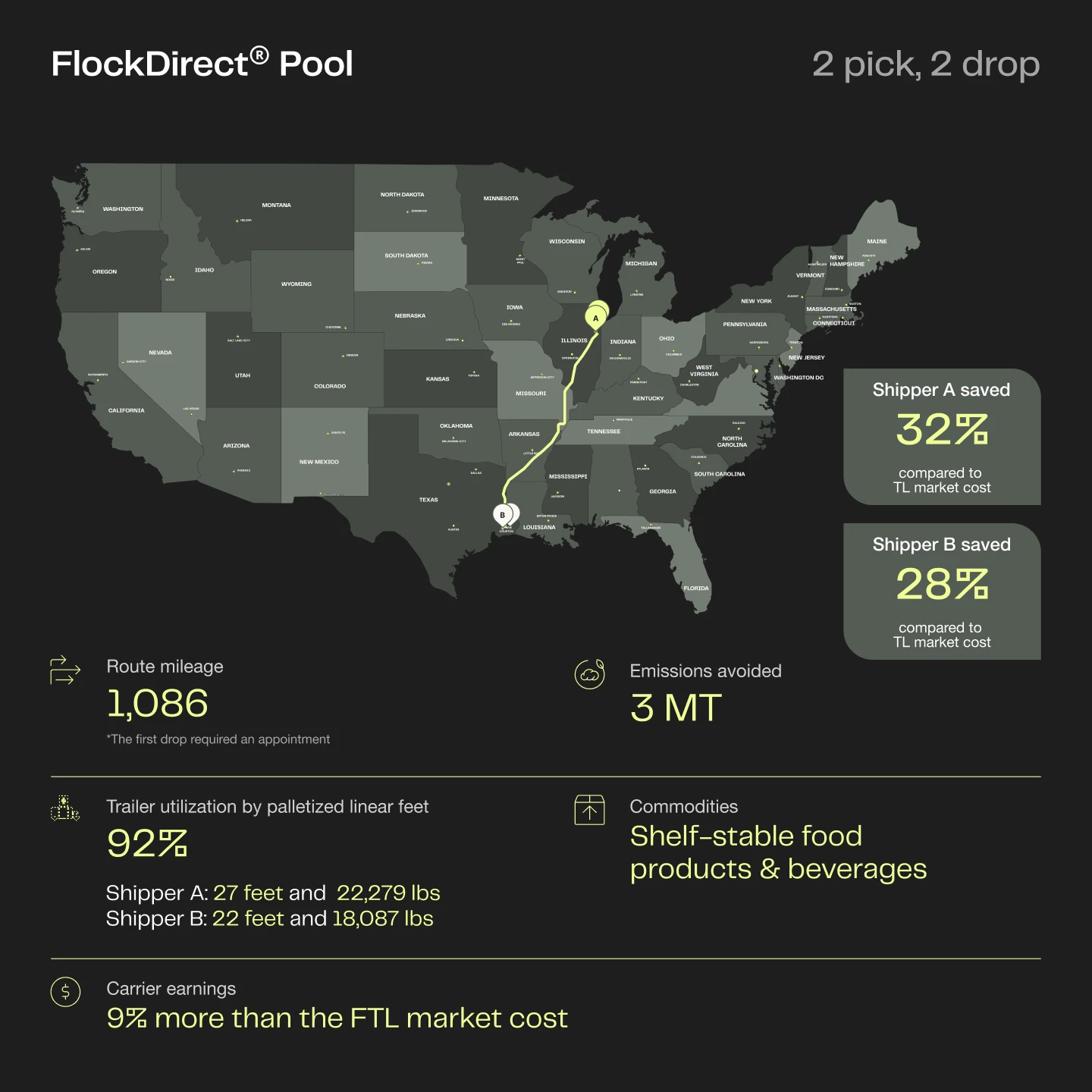
Ever wonder what a FlockDirect® Shared Truckload looks like in practice or its real-world impact? Join us on a virtual road trip to see how our recent FlockDirect® shipments are redefining traditional shipping.
What Should Shippers and Carriers Do Now?
The market is likely to remain volatile and inflationary through the end of 2026 and into early 2027. Shippers should monitor lane and carrier performance weekly and keep routing guides flexible. Don’t be afraid to change your awards to partners and modes based on lane economics.
For carriers, informed routing decisions remain essential because higher rates do not automatically translate into higher profitability. Staying out of the trap of hauling empty space will help you avoid wasting diesel, and remaining diligent on service metrics helps maintain close shipper relationships that will pay off in the short and long term.
For both sides of the market, the best approach is to stay close to the data, have contingency plans, and adjust quickly as conditions change.
Shared Truckload can help offset freight inflation for shippers by combining compatible shipments into a single trailer and paying for the space used rather than an entire trailer. Flock's latest Shared Truckload Rate Index shows savings of 28% to 42%, depending on the lane. Carriers can get the most value out of every gallon of diesel by hauling fuller trailers and combining two shipments into a single trip, maximizing the value of their time on the road.
Chris Pickett is Chief Commercial Officer at Flock Freight, where he leads commercial strategy, pricing, and network development. He brings over 25 years of experience at the intersection of transportation, technology, and market economics, including 14 years at Coyote Logistics, where as Chief Strategy Officer he helped grow the company into the second-largest U.S. truckload broker at over $4 billion in revenue. Chris is the author of a widely used U.S. truckload market forecasting methodology, which he publishes monthly through Pickett Research, LLC. He holds degrees from Virginia Tech, Georgia Tech, and MIT, where his graduate research focused on supply chain resilience.