Freight Market Update for Q3 2026: Rate Inflation and the Rising Cost of Shipping Air
Flock Freight's Q3 2026 Market Update breaks down a market well into its Y/Y inflationary climb. Spot linehaul rates are accelerating, diesel prices remain a wildcard, and long-dormant demand is finally showing signs of life. This quarter, we unpack the data behind the surge and what it means for your budget. Read on for expert insights to help shippers and carriers stay resilient through the back half of the year.
A Note from Chris Pickett, Flock Freight's Chief Commercial Officer
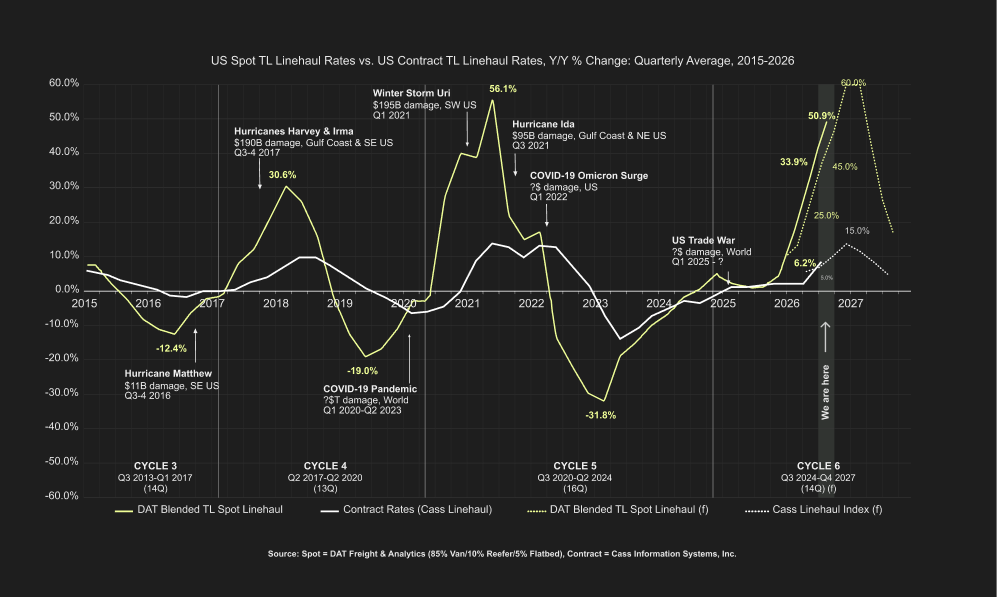
We are now three quarters into the inflationary leg of this new truckload rate cycle. Q2 closed at just shy of +34% year-over-year for spot linehaul rates, versus our +25% forecast, and Q3 is already opening around +51% versus a forecast of +45%. What a difference a quarter makes. The upward movement that accelerated in earnest in Q1 has only picked up the pace, and we are now firmly in the middle innings.
For shippers, that means the penalty cost from shipping air is up roughly 50% year-over-year right now, but so is the savings opportunity. Expect that figure to hover here and settle toward our +45% forecast as the quarter plays out. It’s useful to think of the yellow line on our chart as a proxy for the penalty cost of shipping air, and it is only going up over the balance of the year and into 2027. When rates surge like this, the most no-brainer move out there is to stop paying for increasingly expensive full truckload capacity that you do not need.
Our guidance is clear: we expect spot linehaul rates to peak near +60% year-over-year, as early as Q4 2026 or as late as Q1 2027, before peaking Contract rates, sitting at +6.2% year-over-year in Q2, should follow suit and peak around +15% by early 2027.
If you are not prepared for this level of rate inflation, now is the time to rethink your transportation strategy to protect your budget and start playing some defense. At Flock, we deliver Shared Truckload at scale, so you only pay for the linear feet you take up on the truck while still receiving truckload-like service. Shippers can offset rising freight costs, cut carbon emissions, and build a more resilient network. Meanwhile, the carriers hauling that freight top off underutilized trailers and maximize revenue yield on every foot of space and every mile driven, a benefit even in the highest rate markets.
What Freight Market Trends Should Shippers and Carriers Watch in Q3 2026?
Several critical forces are shaping the Q3 2026 freight market:
- Diesel prices: Diesel is on a seesaw, driven by the on-again, off-again conflict with Iran and movement through the Strait of Hormuz. At the time of this blog, diesel is down 15% from the May peak, but still up about 30% from February pre-war levels. Higher diesel props up contract routing guides, while a sustained drop would push more freight into the spot market.
- Demand joins the party: After a mostly supply-led correction, green shoots are emerging. The ATA truckload volume index broke inflationary at +2% year-over-year for the first time since Q4 2022, the Cass Shipments while still year-over-year deflationary is pointing higher, and the inventory-to-sales ratio fell to 1.29, its lowest since Q1 2022, signaling a growing need to restock as we get closer to Q4 peak retail season.
- Consumption and industrial activity: Consumption remains solid and industrial activity is showing early up-and-to-the-right movement, pointing to a more buoyant volume environment for the back half of the year.
- Seasonality and bid season: End-of-summer demand from food and beverage, patio and gardening, household goods moving, and back to school, plus contract bid season resetting routing guides from late Q3 into Q4, will likely create additional volume growth.
- Supreme Court ruling: The recent ruling on Montgomery v. Caribe made logistics news headlines but we think it’s worth clarifying that we don’t expect it to move the Q3 market. At least we haven’t seen any evidence yet.
Key Freight Market Numbers for Q3 2026
- Q2 spot rates: Closed just shy of +34% year-over-year, above the +25% forecast.
- Spot outlook: Opening Q3 around +51% year-over-year, with a projected peak near +60%, another 15% to 20% move from current levels. At peak, our linehaul index likely reaches $2.90-$3.00 per mile, or roughly $3.50-$3.75 all-in with fuel surcharges.
- Q2 contract rates: Closed at +6.0% year-over-year, slightly above the 5% forecast.
- Contract trajectory: Contract rates should keep climbing, peaking near +15% year-over-year by early 2027 before turning over.
Shared Truckload Spotlight
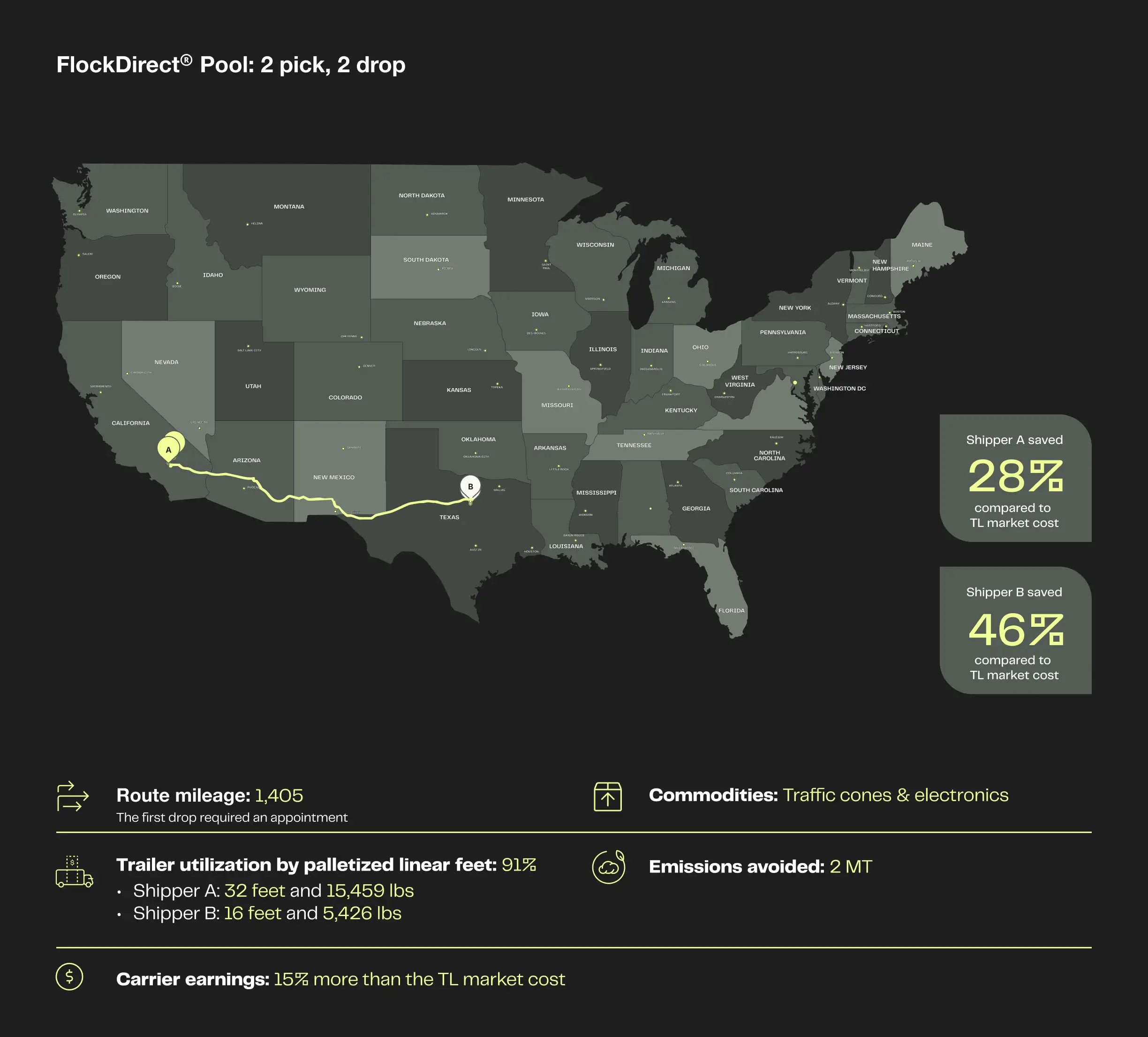
Ever wonder what a FlockDirect® Shared Truckload looks like in practice or its real-world impact? Join us on a virtual road trip to see how our recent FlockDirect® shipments are redefining traditional shipping.
What Should Shippers and Carriers Do Now?
The freight market is poised for continued volatility and sustained rate inflation through the end of 2026. Shippers will have to adapt to rising rates and tight capacity by optimizing networks and leaning on solutions like Shared Truckload to reduce freight costs. The average $200M Flock customer saves $2M each year with STL, and customer savings climbed 45% year-over-year, because you only pay for the space you need.
Carriers will enjoy the market swing after a tough few years, but protect your shipper relationships, because these conditions will not last forever. For small carriers pinched by diesel, keeping your trailer full helps offset those costs, and pooling loads through Shared Truckload increases earnings regardless of fleet size. Whether you are a carrier or a shipper, Flock's team of experts is here to support you when you need it most. Stay tuned for more freight market news next quarter.
Chris Pickett is Chief Commercial Officer at Flock Freight, where he leads commercial strategy, pricing, and network development. He brings over 25 years of experience at the intersection of transportation, technology, and market economics, including 14 years at Coyote Logistics, where as Chief Strategy Officer he helped grow the company into the second-largest U.S. truckload broker at over $4 billion in revenue. Chris is the author of a widely used U.S. truckload market forecasting methodology, which he publishes monthly through Pickett Research, LLC. He holds degrees from Virginia Tech, Georgia Tech, and MIT, where his graduate research focused on supply chain resilience.